Friday, 18 June 2010

The Beetles come to Blashford

There were four of them and they were quite "fab", but they were all ladybirds. Both in the moth trap and just around the Center there were lots of ladybirds today. In the trap were several Orange Ladybirds and a single Cream-spot Ladybird (pictured). Neither species is at all rare, although it was thought that Orange Ladybirds were quite uncommon until moth trappers started to record them, when it was realised they are actually quite common.
The other two of the four were a Ten-spot Ladybird and several of the alien Harlequin Ladybird, the one pictured is the black from with red spots, which is a little less common than the red from with black spots. This is a large species which eats other ladybird larvae as well as the usual aphids. It arrived in Britain in the last few years and has rapidly become the commonest species over a very large area. It came originally from SE Asia but has been introduced into N. America and Europe and is probably now the world's commonest ladybird species.
The Little Ringed Plover chicks still survive as do the Lapwing chicks. The Common Terns are also still doing really well, the oldest brood are starting to flap their growing wings and will be flying before too long. Most broods are still of three, which means they have not lost any chicks as they almost never pay more than three eggs.

Thursday, 17 June 2010

A Raft, is a Raft, is a Raft

We still have three Little Ringed Plover chicks surviving and the weather still looks alright for the next few days at least. Overnight moth trapping did produce one new species in the form of a Clouded Buff, a heathland species that had probably wandered down from the New Forest. It regularly flies in the daylight and the only picture I could get was in the trap as it flew off almost immediately afterwards.
The big task of the morning was trying out some raft designs, you might think there would not be much choice, but if so you had not bargained on the ingenuity of the Blashford volunteers. The object was to come up with a frame design which will support a plastic pie filled with bottles, to provide floatation and infilled with coir fibre which will act as a planting medium for a range of marginal plants. There were not quite as many designs as people but it was a close run thing, there was the "Tortilla Chip".Some favoured a less angular approach and so the "Oval" was born, although the lack of a food based name may count against this one.
There was also the simple approach a square grid, the "Battenberg".
Another circular design based on an asterisk shaped frame produced the "Pizza", seen here with the filling as well.
Of course we had to check if the raft would actually float so we carried two completed ones to water, luckily they did.
The raft frame is made of recycled plastic lumber, made from old plastic bottles and other plastic waste collected by recycling schemes in Britain. It should be durable and rigid enough that they will not get pulled apart when anchored on a windy lake. They will be planted up with plants collected from around the shore of the lake, so we can avoid introducing any more alien plants. The project is aimed at reducing nutrients in the lake which can lead to unwanted algal blooms, the rafts should also provide nesting sites for birds like Great Crested Grebe and Coot as well as cover for fish and invertebrates.
In the afternoon we had a Dragonfly Walk, thanks to the sunshine we did pretty well, seeing ten species of dragon and damselflies. These included at least 3 Scarce Chaser, including a pair mating at the Ivy south hide. A particularly fine male Emperor dragonfly perched low down beside the path was also highlight as was the sight of the dragonflies greatest enemy in the shape of two hunting Hobbies.

Wednesday, 16 June 2010

When to Give Up?

A new day dawned and all three of the Little Ringed Plovers running around yesterday evening were still doing so, a minor triumph in itself. However the last egg was still just an egg, now some twenty-two hours after the last of the three chicks had broken free. I was not able to look in during the morning but several people watched as events unfolded.

All morning the female kept returning to the egg, sitting for a time before being drawn away by the need to look after her three animated fluff-ball chicks. Eventually in the late morning and just about exactly twenty-four hours after the third egg had hatched, she gave in and left the last egg. It was evidently infertile, but her urge to hatch it was very strong and she was reluctant to give up.

By the end of the day all three chicks were still running about, so far the weather has been set fair and the family is deriving some "air cover" from being near the Lapwing pair with their one remaining chick. However the fact that, despite being very active at chasing off predators, these Lapwings have steadily lost their chicks, is a warning for what could be in store for our plovers. As well as these birds there is also another pair of Little Ringed Plovers with one chick about a week old just to the east of the hide and a family of younger Lapwing chicks a little further away again.

Apart from when doing a BTO Atlas visit that included the Linwood reserve first thing this morning I did not see much wildlife today. I spent a while collecting together the last of the materials for the rafts, we hope to have a go at making a few trial ones tomorrow, so more on these later. Once again thank you to people who brought in plastic bottles, I now have a fair few but could still do with loads more. I now have a "Bottle Bin" by the Centre door, in case anyone out there has any bottles to donate.

The rest of the day was spent in a range of tasks including path trimming and clearing a fallen tree along the Rockford path. I took a quick look at Rockford Lake as well and there were 76 Canada Geese and 3 Greylags, no doubt they will stay there to moult now. It is interesting how Rockford Lake attracts Canada Geese whilst most of the Greylags go to Ibsley Water to moult. I have had a couple of goes at counting the geese on Ibsley Water, but so far they have always been too spread out to see from any one point, suffice it to say there are something like 300 Greylags there as well as a good few Canadas and a Bar-headed Goose.

Tuesday, 15 June 2010

Latest Score: Springwatch 1 - Blashford 3

We had been waiting and today it happened, the Little Ringed Plovers at the Tern hide started to hatch, by the end of the day three were out, although one still had down damp from the egg. The two older ones were already running around looking for all the world like cartoon versions of the adult bird. Somehow, although quite different they still capture the essence of Little Ringed Plover, just like a great cartoon image. One egg remains to hatch, so perhaps tomorrow morning there will be four, if they survive their first and probably most dangerous night. The road to fledging remains fraught with danger but at least they have hatched so it is a road they have at least started out on. As Springwatch has recorded, their plovers had three of their eggs taken by a Jackdaw, the life of a Little Ringed Plover parent is not without tragedy.

I spent most of the day accompanying a student looking into the biology of a mayfly that lives in the Dockens Water. I took the chance to do some insect survey along the stream. One of the first things I came across was a fine female Scarce Chaser dragonfly, the picture I got of it is rather better than the one I posted a couple of days ago!
As the sun came out so did the damselflies, at the southern end of the stream there are quite a few Banded Demoiselle, but go a little north where the stream is stonier and they are all Beautiful Demoiselle. The picture shows that although beautiful they are really killers, the big eyes see the prey, the long spine son the legs are used like a net and the jaws make short work of a range of small and not so small insects.
It was not all insects, I found a number of Broad-leaved Heleborine plants, not yet in flower but nor far off. Long sections of the banks, where the sun gets through are dominated by Water Forget-me-not, one of several species of these plants found on the reserve and by far the largest.
In the sunny patches along the path beside Ellingham Lake there were large numbers of bush cricket nymphs, mostly of Dark Bush Cricket but there were also several Speckled Bush Crickets, like the one below. They really are speckled and much easier to see as nymphs as the adults tend to climb up into the trees out of reach.
The flowers attract lots of insects and several beetle species are now coming to those of Dog Rose and the first of Bramble. One common species is Oedemera nobilis known very unofficially at Blashford, as the "Thigh Beetle", after the swollen hind legs of the male.
Thanks to those who have already given me plastic bottles (and tops), I still need them though, it seems the one litre size in most drinks is the best fit of all, but many up to about 1.5 litre are OK as well, so if you have any and are coming to see the plovers, there will be a bin outside the Centre for donations.

Monday, 14 June 2010

Have You Got the Bottle?

We are about to start making vegetated rafts and we need plastic bottles to provide floatation. I have just calculated we will need hundreds of them. So if you are coming to Blashford a donation of a plastic bottle or two, with the lids on, would be most welcome. Any size below 2 litres would seem to be fine. So if you have got the bottle, please think of us.

Sunday, 13 June 2010

Snakes and Skimmers

A much better day than I had expected today, mostly sunny, especially in the afternoon. At the start of the day when I opened up the Ivy South hide there were two Grass Snakes on a log in front of the hide, both were a good size, the picture shows the larger one.
During the morning there was a group in taking pictures of the moths and other wildlife. In the afternoon the local New Forest west group of the Wildlife Trust had a pond-dipping event.
As usual the pond produced a wealth of pond life including a lot of newts. Most of the newts we get are Smooth Newts, but some are the scarcer Palmate Newt, but the differences are not that great. The male Palmates have a smaller crest, less colourful underbelly, narrow hind toes with slight webbing at the base. The spots along the tail are also arranged in lines rather than more scattered as they are on Smooth Newts.
Also caught were damselfly larvae, water-beetles, water boatmen, pond skaters, freshwater shrimps, leeches and of course, pond snails. The snail below was drifting just under the water's surface, to em there is a bit of the elephant about, or perhaps hippopotamus.
The sunshine certainly brought out a good few insects, out on the lichen heath there are now quite a lot of adult Field Grasshoppers, always the first species we see they will chirrup away until autumn. The picture is of a male, they are easy to identify as they have hairy chests!
At the pond there were also several dragonflies, including a new species for the reserve, the twenty-sixth species of Odonata recorded. It was a Keeled Skimmer, a species that is quite common on the New Forest and one I had been expecting to turn up sooner or later.
More frequent and probably hatched out from the pond behind the Centre was a male Emperor Dragonfly, this is Britain's biggest dragonfly and one of the commoner species. This male was catching and eating damselflies in between sitting in the sun.
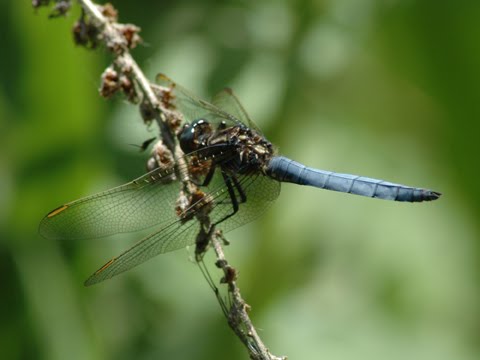
There were also single Four-spotted Chaser and two Scarce Chaser, a male and a female. The male disappeared quickly but the female was around for much of the afternoon. I did not exactly get a good picture of it, but the shot does show the diagnostic darkened wing-tips especially well.
The Little Ringed Plover are still sitting near the Tern hide, but should hatch this week, although another nearby pair seem to have lost their clutch. The Lapwing pair with two chicks are still surviving and there was also a second brood today, with four small chicks. So far the Common Terns are still going well with the adults bringing in fish regularly.

Friday, 11 June 2010

The rain never really came so the moth trap once again contained a good catch including a Beautiful Brocade, a species of heathland that is still scattered around the New Forest but much less common than it used to be. Only a handful are recorded each year so one at Blashford was certainly notable. It is one of the great advantages of Blashford that it is an area of good wildlife habitat that lies beside two others, the New Forest and the Avon Valley. As well as the moths the trap also had a wide variety of other insects including many flies. One was a male horsefly, harmless as only the females bite, it was a striking insect with almost totally black wings and the most amazing eyes. The species is Chrysops caecutiens the females of this species have yellow markings and wings with a pattern of clear areas and black, they are also persistent biters. Curiously I have only ever been bitten by common species, even when I have found rarer ones they seem to take little interest in biting people. Despite the painful bite that some can give they are a remarkable group of insects including some of the fastest fliers and most aerially acrobatic.
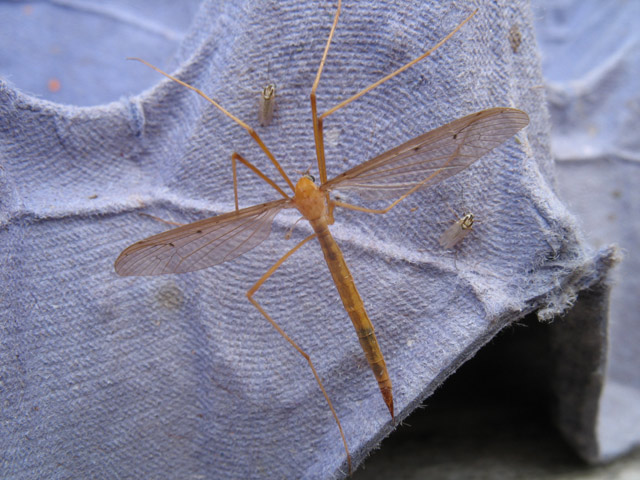
Other flies included Britain's biggest cranefly, Tipula maxima and this rather smaller pale species with an unusually long abdomen, I have no idea what it is, there is a key to these flies but I have never had much success with it.
Little new to report on the bird front today, but the Lapwing chicks are still going, or at least two of them are. I had reports of the two Little Ringed Plover chicks and the clutch near the hide was still incubating as was the Oystercatcher. All still seems to be going well with the Ivy Lake Common Terns and the three Mute Swan cygnets are growing well.