Thursday, 10 June 2010

Land of the Giants

Despite continuing damp weather the various young birds still seems to be doing OK, on Ibsley Water the Lapwing, Little Ringed Plover and Shelduck families are still running and swimming around. The many Common Tern families on the rafts on Ivy Lake also still seem to be getting lots of food and growing well with several broods of three chicks.

Cloudy nights mean warmth and lots of nocturnal insects, a good range of moths, but little of great note. The most interest insect was a Giant Lacewing, these are much bigger and quite different from the familiar green ones so common in gardens. A rather poor picture, taken under dull skies below.
Another Thursday and another volunteer task, today it was Himalayan Balsam pulling. At first there did not look to be much, but a closer look, unfortunately, revealed the truth hidden amongst the nettles. It was not all bad though, the dull weather meant that the vegetation had hundreds of Common Blue Damsels clustering on it, flashes of electric blue on a grey day. We also came across a male Scarce Chaser sitting quietly on a bramble. Toadlets are increasing and a few froglets were about as well today.

Next week's task will be trying to build rafts that will grow emergent water plants like Yellow Flag, sedges and reeds. The materials continue to be delivered and there is now a growing range of unlikely items building up in the yard. Hopefully more of this with pictures of wonderful rafts next week.

I saw few birds today, but people in the Tern hide this afternoon were rewarded with three separate sightings of the Osprey.

Wednesday, 9 June 2010

The Dangers of Over Protective Parenting

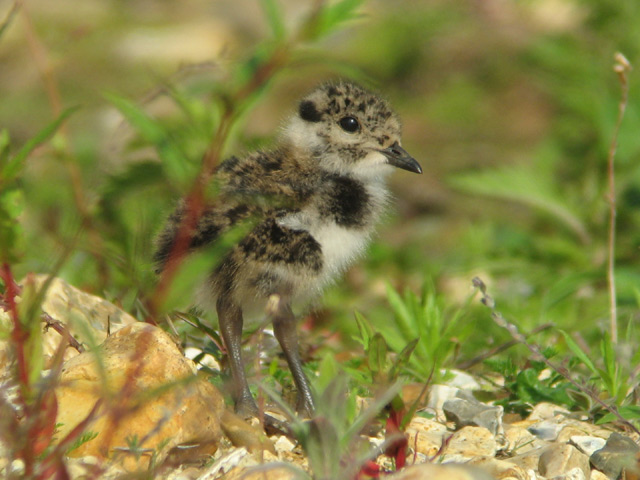
At the Tern hide when I opened up an Egyptian Goose being dive bombed by the pair of Lapwing outside the hide was unexpected, they successfully drove it off. Perhaps because they take such a robust approach to parenting they still have all three of their chicks, although this may not be an entirely good thing as I will explain later.

I opened up the Ivy South hide in steady rain, despite this the Grass Snake was on the log in front again, not very lively though, but it did give the chance for a picture.
The cloud cover overnight meant the temperature did not drop much and as a result there were a good few moths in the trap including several Hawk-moths, including the first Privet Hawk of the year. This has a good claim to being the largest resident British Moth, there are one or two larger ones that arrive as migrants but they do not survive here year round even if they do sometimes breed here.
There were also a couple of Eyed Hawks, one fell off when I was checking the egg boxes, as a result it went into threat display, showing the eyes that supply the name.
I also a caught one species that was entirely new to me, a distinctive tiny moth called Telechrysis tripuncta, a woodland species and seemingly quite scarce, or overlooked.
At the end of the day when I went to the Tern hide the Lapwing chicks were right outside the windows, unfortunately this had resulted in the adults deciding the sitting Little Ringed Plover was an unacceptable risk to the chicks and they had driven it off the eggs, which had not been incubated for about half an hour. The female was sitting again when I got there and as it had not been raining and was quite warm I think there is a good chance the eggs will have survived, however it shows that it is not just predators that can cause nest failure.

Tuesday, 8 June 2010

Moths and Millions

Despite having about 12mm of rain (half an inch in "old money") overnight, there were a good few moths in the trap this morning. The best was another Scarce Merveille du Jour, the bulk were a few common species especially Treble Lines, White Ermine and Heart and Dart. The last is a very common species and one that probably occurs in every garden in Hampshire, perhaps even England. It is named as because the markings on the wings are supposed to resemble a heart with a short black dart, you can decide if there is any basis to this.
White Ermine moths are pretty obvious and like most "tiger moths" distasteful to birds, if disturbed they will drop to the ground and assume the position in the picture, which does look sort of threatening, or at least like the kind of insect that might potentially sting. The abdomen has something of the wasp about it.
The Lapwing chicks still survive and our first brood of Little Ringed Plovers were running about today, although the clutch nearest the hide are still being incubated. The Osprey turned up again, in fact it made two appearances, the last around 4 o'clock, which seems a favourite time.
When the sun came out there were loads of damselflies and dragonflies about, which was not too unexpected. However in the rain during the morning a large Grass Snake trying to bask outside the Ivy South hide rather optimistic. More typical of the conditions were the first toadlets on the move, only tens today but the hundreds, thousands or even millions are probably only days away. They can be so abundant that it is impossible to walk the paths without treading on some, densities may exceed 10 per square metre, that is 100,000 per hectare!

Monday, 7 June 2010

Mulleins, a Marvel and a Mullet Hawk

So far so good for most of the nesting birds, the three Lapwing chicks survived another night, as did the sitting Oystercatcher and Little Ringed Plover. When I opened up the Tern hide I saw the Greylag family in the picture below, perhaps surprisingly they are one of the threats to the Little Ringed Plovers. The family wander about on the shore and their big feet are at real risk of crushing a nest of eggs, they also take more or less not notice of being chased or distracted from their course by agitated plovers.
As I left the hide I noticed a tattered Mullein plant and on the leaves several brightly coloured caterpillars of the Mullein Moth. They are distasteful to birds so have no fear of sitting in the open. As always seems to be the case the several caterpillars were of sizes ranging from quite small to almost full grown, I have never known why this should be, possibly they are the result of several layings.
Another good haul in the moth trap overnight included a Miller and a Scarce Merveille du Jour, pictured below. This is a species of ancient woodland and exists at Blashford thanks to the woodland corridor along the Dockens Water. Although not as spectacular as the rather similar Merveille du Jour, which flies in the autumn, it is very distinctive.
Also in the trap was the rather fine Caddisfly below, it was a real whopper as well as being rather well marked.
When I went to lock up at the end of the day I was told of various interesting bird sightings, the Osprey had been seen again and the Black Swans, which were there first thing, were still present. The pair of Shelduck, still with two ducklings, had also been seen, although one had been grabbed by a Great Crested Grebe at one stage, apparently a typical underwater attack, but fought off by the adult Shelducks. They had also just seen a Hobby catch a Sand Martin in front of the hide, so all in all they had a good afternoon.
Note: Mullet Hawk was an old name for the Osprey, particularly suited to them on the south coast where this fish seems to be one of the main prey items.

Sunday, 6 June 2010

A Day for the Chicks

Don't worry I am not having a retro moment, there really were lots of chicks about at Blashford today. At the Tern hide the three Lapwing chicks that were first seen yesterday spent the day on the shore in front of the hide, they have along way to go if they are to fly, but they have at least survived another night. In the distance lots of Black-headed Gull chicks can be seen on the island at the top of the lake.
Also from the Tern hide a pair of Shelduck were bobbing about with their two ducklings, I can't help feeling they would have had a lot more at hatching, but these were only a few days old at most so the loss rate has probably already been alarming.
On Ivy Lake the first of the Common Tern chicks on the rafts have hatched and I expect the others will not be far behind.

The slightly unexpected warm sunshine made for a good insect day, there were Scarce Chaser dragonflies, Emperors and a Four-spotted Chaser. Towards the end of the day I was outside the Center when a huge parasitic Ichneumon wasp Rhyssa persuasoria, I was not quick enough to get a picture, but look it up on the web and see if you would be happy to have one land on you! It was actually harmless, at least to me but magnificent to look at.

The highlight of the day was a moth, although not much to look at the Lunar Yellow Underwing is a real find. It is a nationally notable species that is mainly found in the Breckland area of Norfolk. It had been recorded from Blashford before, a few years ago, but it was uncertain if that one was a wanderer or part of a local population. The dry sparse grassland that is found in places on the reserve is just right for it but there was no evidence it bred here. Today's moth was very fresh and put together with the earlier record makes it more or less certain that there is a local population.
Other moths included Poplar Hawk, Eyed Hawk, Elephant Hawk, Buff-tip, Light Brocade, Vine's Rustic and various others, in fact probably the best night of the year so far.

On a day when birds were few the return of the Osprey was the highlight, it was reported circling over Mockbeggar Lake.

Wednesday, 2 June 2010

Bugs and Badgers (again)

No birds of note today, but I can report that all the various birds sitting on eggs are still doing so, a case of so far so good. After yesterday's rain it was sun again today and looking by the pond at the Centre there were lots of insects. The Hoverfly below is a species called Parhelophilus frutetorum a species typical of ponds with lots of emergent vegetation.
There are also lots of dragonflies emerging now, the exuvia below is of an Emperor, it always amazes me how many can emerge from such a small pond. On the wing today were Broad-bodied Chaser and Scarce Chaser as well as hoards of damselflies.
The area just outside the Ivy North hide is always good for butterflies and there were several Common Blue, Dingy Skipper and my first Brown Argus of the year there today.
The Badgers have been busy again making new holes, including another right beside the path. In fact I am watching them as I write this via the webcam, they are brilliant value at present, they are out in front of the camera every night. Just now one is digging out new soil from a hole just on the left of the path in the picture and earlier two were beside the log in the background.


Tuesday, 1 June 2010

An Elephant and a Group of Arctic Travellers

Not a day for pictures so only words today. The overnight cloud, without the promised rain resulted in a good catch of moths including some migrant species in the shape of a Silver Y, a Dark Sword-grass and a Gem. There was also the first Elephant Hawk-moth of the year as well as several Poplar Hawks and an Eyed Hawk.

From the Tern hide first thing a small group of waders in the rain included the first Turnstone of the year, along with 5 Sanderling and 2 Ringed Plover. These are all real high Arctic breeders and they are still in time to breed there this summer, if they get a move on. That said they departed to the south-east, so perhaps they will not make Greenland after all.

The Great Spotted Woodpeckers have fledged but were back in the nest hole in the heavy rain, but I don't expect them much after this. The Common Terns are sitting well on the rafts on Ivy Lake, the rain meant all were sitting tight giving a good chance to count the nests, I think there are sixteen sitting birds, at least. Unlike last year, they laid more or less at the same time, so hatching should be more or less together.