Showing posts with label moths. Show all posts

Saturday, 20 August 2011

Friday, the Night

Friday night was moth night. It was billed as "50 Mighty Moths", it was always going to be a tall order, especially when the evening cleared to a fabulously starry night, just what you don't want, moths like a dense blanket of low cloud to keep in the warmth. Possibly the highlight was a moth I found on the shed wall in the afternoon and potted up to look at later, a magnificent red underwing and yes they do have red underwings, you just can't see them in this picture.
We had six moth light running at various points around the reserve and on trees beside the paths we put out "Moth gloop" the sugar mixture that some species will come to feed at. There was much doubt about the gloop in some quarters, but more of that later. We first emptied Thursday night's catch ands so stared with sixteen species and the red underwing, thirty-three to go. One of the more attractive species to arrive quite early in the evening was the brown china mark, the larvae of which feed on water plants in ponds.

An autumn species that has just started to appear in the trap recently is the flounced rustic
not the most colourful species but quite attractive for all that.

One or two species turned up in some numbers, common carpet certainly lived up to the name and there were good numbers of sharp-angled peacock, pictured below.
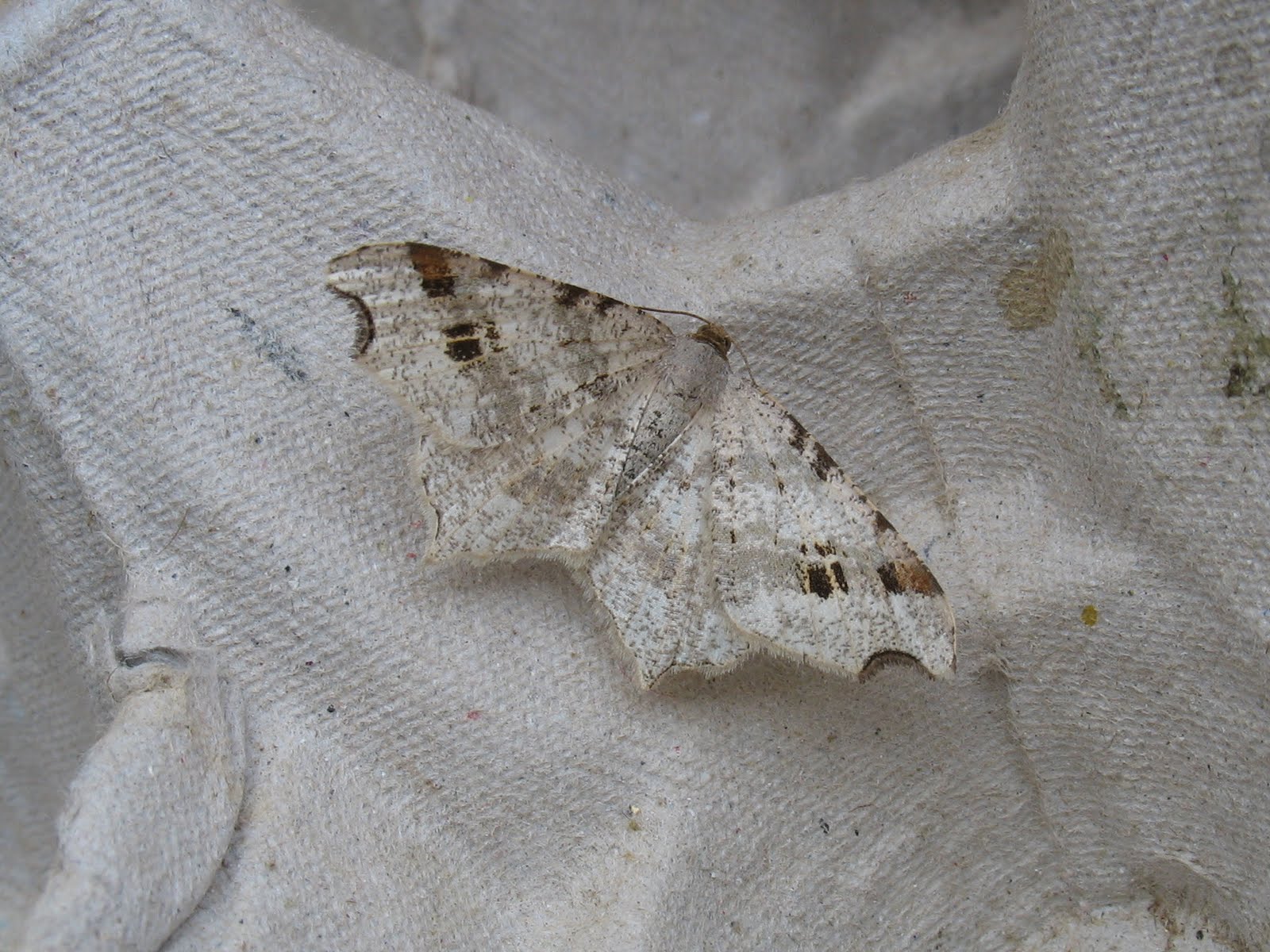

Despite the doubts the gloop did produce some slight result, just two moths, but ones that we did not see at the lights, a copper underwing and best of all an old lady moth. Both these species are not attracted to lights very much but do like sugar. The sugar did attract a lot of other creatures though including earwigs, harvestmen, and woodlice. We also saw lots of slugs, snails, millipedes and ground beetles heading up the tree trunks. The lights also brought in a variety of other things as well, including mayflies, caddis flies, midges, parasitic wasps and bugs like the forest bug below.

Two light traps were run all night and produced the following species, in no particular order:

common carpet, green carpet, riband wave, small fan-footed wave, common wave, common white wave, light emerald, canary-shouldered thorn, sharp-angled peacock, small phoenix, straw dot, snout, pinion-streaked snout, mother of pearl, black arches, poplar hawk, square spot rustic, large yellow underwing, vine's rustic, shuttle shaped dart, flame shoulder, dunbar, lesser swallow prominent, pale prominent, spectacle, flounced rustic, dingy footman, rosy footman and nine species of micro moths, making 37 in all. Several species were seen only in the evening and not caught in the traps, including the old lady, copper underwing, iron prominent, lesser treble bar and another three species of micros, making 44. If I add in those that we saw as well let Thursday's catch go we gain setaceous hebrew character, common rustic and white-point, making 47, then we have the red underwing, to make 48. Unless I have forgotten some that would seem to be it, so we came up two short, actually not at all bad on a cool night.


We did also have several bats including pipistrelle, soprano pipistrelle, Daubenton's bat, possibly a serotine and a tantalising brief detection way up in the 90+hz range.


Sunday, 3 October 2010

Rain Fails to Stop Work or Cricket

This morning's rain stopped play at the Ryder Cup but it was not nearly enough to stop Blashford's volunteers. In fact we used the opportunity of the rain soaked tree branches to identify those that were most likely to bend down and reduce the headroom or the width of the paths. More or less as soon as we finished work the rain stopped, shortly after the sun came out, albeit briefly.

A wet night meant a cloudy night and that equals a warm night and a warm night means moths. Last night's catch included a beaded chestnut one of many "autumn only" species.
Another, although rather more common autumn species is the very variable lunar underwing, if you wonder why it has this name, it is because it has a crescent shaped mark on the hind-wing, although this is covered by the fore-wing when the moth is resting so you never really see it.
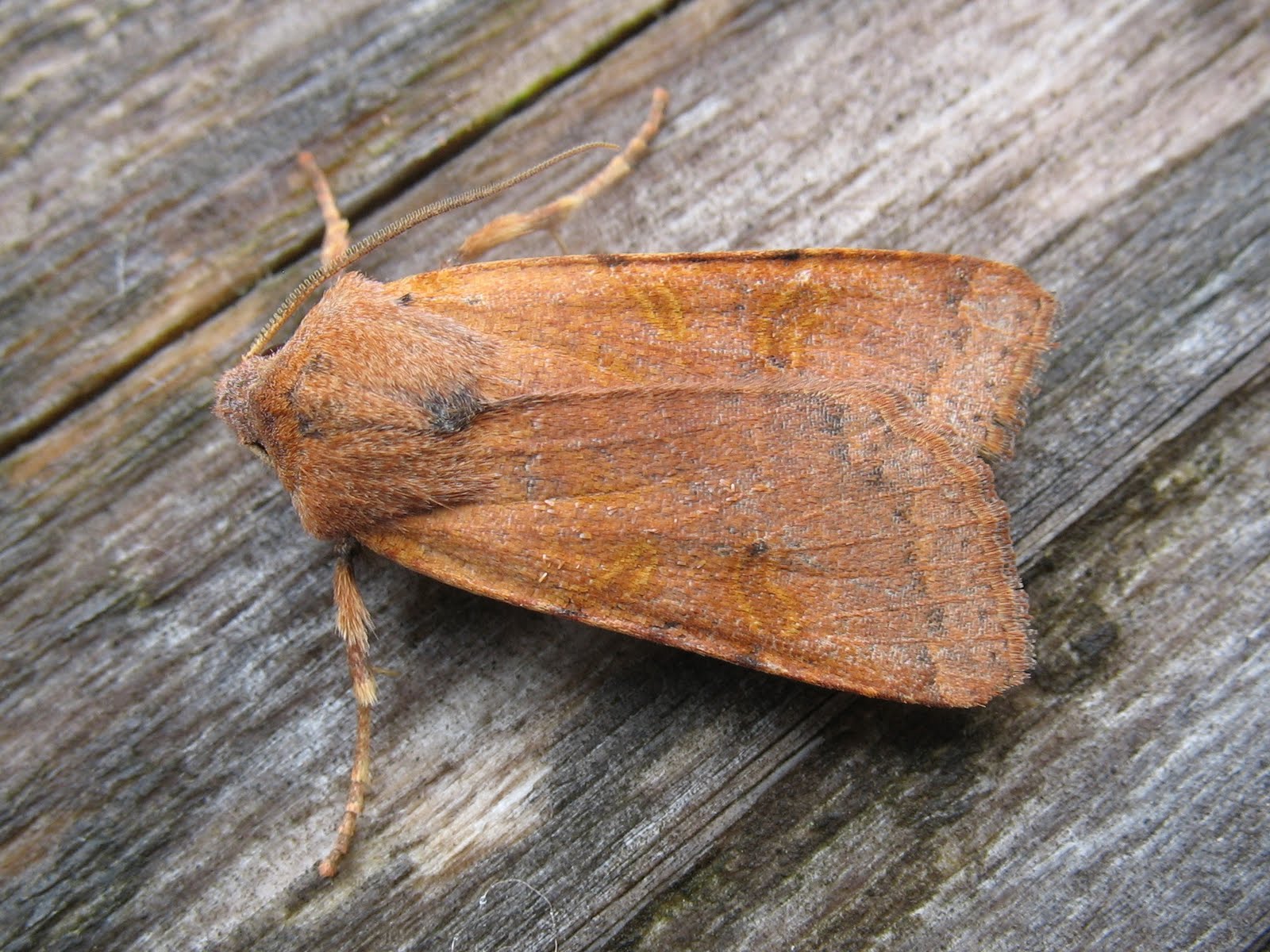
A lot of the autumn moths are orange or yellow, no doubt this camouflages them amongst autumn leaves, one such species is the sallow.
Some autumn flying moths have two broods a year. The setaceous Hebrew character is one of these, with a brood that fly in the mid-summer period and a second flying in the autumn.
Last of the moth picture from last night is a feathered thorn, it really doe shave feathery antennae, although this one refused to show them for the camera.
The early rain resulted in large numbers of swallows and martins feeding low over the lakes, today most were swallows, with perhaps 800 over Ibsley Water and Ivy Lake first thing. Numbers of martins were lower, but there were still about 50 sand martin and 200 house martin. Many of the house martin were not low over the water though, they seemed to prefer feeding around and just above the trees.
At lunchtime most of the swallows had dispersed as the weather improved. A visit to Tern hide to eat my sandwiches was largely quiet apart from 2 Egyptian geese and a little stint. The range was such that the stint was identified by probability, I suppose it could have been a semi-palmated sandpiper, well I can dream can't I?
I will end with another insect, one that I hear quite regularly during the summer but rarely see, despite searching. I have found the recent damp, mild mornings are just right for finding them, they are wood crickets. These are true crickets and chirrup softly in the leaf-litter, but the calls are hard to locate accurately and they stop if you get too close. However it seems they forage out on the shingle around the Centre on damp mornings and head back to shelter just about when I am covering the moth trap. Now that I had found where they were hiding I was able to find one and get a picture of it.
These are called "true-crickets" to distinguish them from bush-crickets. This species is quite common around the New Forest and was probably introduced into this country. We do have a native species in the field cricket, but this is so rare that it is the subject of special work to try and save it. The wood cricket may, or may not, be a native species, it was hardly noted before about a hundred and fifty years ago, perhaps it was much rarer for some reason or perhaps it was newly arrived with plants from the continent as gardening became more popular. The one in the picture is engaged in a little antennae cleaning.


Thursday, 29 April 2010

A Moth with an Identity Crisis?

The last couple of days have been pretty quiet for birds with almost no sign of any arrivals or birds passing through. There has been a good bit of activity though with the arrival of Compostcam and Woodpeckercam to add to Pondcam. I will post more about these later, hopefully with a link. For those that copied the address when I posted it earlier I have to apologise as it now seems to have failed following a power cut today.

Although quiet for birds another warm night was good for moths, highlights included a Herald, another species which has over-wintered as an adult, but this one looked amazingly fresh considering it is probably at least seven months old. The jagged outline of the wings no doubt helps to hide their outline from being recognised by predators during the long hibernation period. Another moth in the trap was a Small Engrailed, this moth is very like the Engrailed, in fact so alike are they that there are no really certain character for telling them apart and it has been suggested that they are not different species at all. You might ask why they could be thought separate species and the answer is in the time they fly. Engrailed moths have two broods, one in late winter and one in late summer, the Small Engrailed flies in mid-late spring, between the two broods of the Engrailed. It has been suggested that the one is just a single brooded form of the other, but if they stick to their timing the two populations will never meet to inter-breed so would be reproductively isolated giving them a fair claim to species status. The picture shows the moth to be not the most exciting to look at but a source of interest and perhaps even controversy for all that.
Having said there were few birds a White Wagtail on the shore of Ibsley water at lunchtime with a group of, presumably migrant, Pied Wagtails was of note. The Common Terns are competing for raft space with Canada Goose, Lesser Black-backed Gull and Black-headed Gull, hopefully they will arrive in force soon and see off these competitors before they get settled. On Ibsley Water the 5 Wigeon remain and are possibly here to stay now, as I locked up there was a fine drake Goosander, no doubt one of the birds that have taken up residence in the Avon Valley in recent years.
Being Thursday, it was volunteer day and twelve people turned out to fill potholes, tidy up the yard and do a variety of other tasks. As usual loads of work got done and the rain held off as it almost always seems to.

Tuesday, 27 April 2010

New Openings and Moth Mysteries

The Blashford Badgers are very active at the moment with lots of new holes being opened up and old ones cleaned out, hopefully this mean there are lots of cubs and perhaps they will get easier to watch. the hole in the picture is a new one opened to the north of the main sett and not connected directly to it, the silty ground makes for easy digging.
The moth trap contained a few more species new for the year. A Pale Prominent was newly hatched but the two others were actually species that hibernate as adults and the moths would be something like seven months old now. The species were a Pale Pinion looking very fresh and pictured below, a local species of woodland and a Dotted Chestnut, which flew away before I could get a picture. This last is quite scarce and the larvae have rarely been found in the wild, those that have been found often seem to favour apple trees and possibly have an association with ants but this is still to be confirmed. Who says there is nothing left to discover?
Birds today were rather unremarkable, or at least much as yesterday. The most interesting exception was a Yellow Wagtail which flew over the Centre when we were eating lunch, sadly a record that does not count towards our BTO Business Challenge total. A singing Sedge Warbler at the Ivy North hide was certainly of interest as they are usually only in the reeds near the Lapwing hide.

Friday, 23 April 2010

Spring Firsts and Swift Wonders

Yet another "Butterfly day", or perhaps a Damselfly Day, as the first Large Red Damsels of the year were reported today, somewhat later than usual, but the winter was a good bit colder. Orange Tips were about in good numbers and a further "first" was a Speckled Wood. As I checked the moth trap a party of Swifts were screaming overhead, a real sound of summer, in about three months most of them will be off south again, so something to enjoy while you can. Swifts are one of the marvels of our world, they live almost totally aerial life, even sleeping and mating on the wing, to watch them for a prolonged time is one of the real transporting pleasures of summer.

To return to the moths, the trap contained the usual scatter of Common Quaker, Small Quaker, Hebrew Character and Clouded Drab, along with two more new species for the year; Powdered Quaker and a Lesser Swallow Prominent, the last pictured below.
On Ibsley Water today there were: 2+ Common Sandpiper, a Dunlin, 3 Common Tern although I could not find yesterday's Goldeneye. The pair of Oystercatcher that have been hanging around the south end of the lake seem finally to have selected a nest site on the small shingle island to the east of the hide. A feature of the lakes just now is the really large number of Tufted Duck that are still around, it will be interesting to see if we have more breeding pairs than usual this year. The pairs in the picture were part of a noisy group outside the Tern hide this morning.
Most of the Black-headed Gulls are settled on the main island in Ibsley Water now, at this time of year they are really smart birds, so I make no apology for including yet another picture, I especially liked the reflections on the underside of this bird.
Nesting update: The Blackbird nest I was following is now empty, I am not sure what the culprit was but the nest was well inside a thick bramble so it was something quite small and agile. The Song Thrush sits on though as does the Mallard up a tree and the Mute Swan. The Great Crested Grebe nest outside the Ivy North hide now has a sitting birds as well. I also saw my first brood of Mallard today as well as a family of Greylag, although the last were a week or so old.
Another year careers along, I wonder will we get a "Black Tern Day" this year? If we do it could be in the next few days, perhaps even tomorrow. If it is tomorrow I will miss it, just like I did the Little Gull day, but then again I will be from dawn on Sunday and who knows what there might be then, a fine spring dawn is always a rare treat.